TK-Ledger Manual
CONTENTS
SYSTEM MAINTENANCE
TRANSACTION ENTRY
ACCOUNT INQUIRY
STANDARD REPORTS
FINANCIAL REPORT WRITER
FISCAL PERIOD CONTROL
CREATING A BUDGET
SPREADSHEET INTERFACE
APPENDICES
INTRODUCTION
Overview
System Conventions
Screen Compilation
System Menus
Multi-Currency Approach
Getting Started
Printer Maintenance
Defining an Organization
Organization Maintenance
Fiscal Period Maintenance
Chart Of Accounts Maintenance
Journal Maintenance
G/L Parameters Maintenance
Division/Department Maintenance
Currency Maintenance
Exchange Rate Maintenance
Transaction Rollback
Making A Journal Entry (Single Currency)
Making A Journal Entry (Multi-Currency)
Printing A Journal Entry
Saving, Recalling and Discarding Standard Entries
Balance Sheet Adjustments
Displaying Account Detail
Changing Currency
Searching For Transactions
Displaying A Journal Entry
Printing Reports
Trial Balance
Journal Report
Account Detail
Income Statement
Balance Sheet
G/L Graphs
Creating A Report
Modifying A Report
Copying A Report
Deleting A Report
Printing A Report Format
Printing A Report
Overview
Opening A New Year
Closing A Period
Closing A Year
Re-Opening a Period
Re-Opening a Year
Establishing A Baseline
Modifying The Budget
Extracting Data From Your General Ledger
A. System Information
B. Default Keyboard Assignments
C. Standard Chart of Accounts
INTRODUCTION
Overview | Welcome to TK-LEDGER, PG&A's comprehensive, multi-user solution for
general accounting and financial reporting. During the design of TK-LEDGER, we sought to combine the ease-of-use characteristics of many PC packages with the strengths of multi-user minis and mainframes. The result, as you will soon see, is a system which is extraordinarily easy to learn, simple to use, and comprehensive in its treatment of your accounting needs. Some of its more important characteristics are explained in the paragraphs which follow. | ||||||||||||||||||||||||||||||||||||||||||||||||||||||||
| Multi-User | TK-LEDGER is a true multi-user application, making it possible for different users to be entering, inquiring or reporting accounting data at the same time. The comprehensive security system on which the system menus are based provides the control necessary to prevent unauthorized access to sensitive accounting data while it also allows authorized accesses to be monitored. | ||||||||||||||||||||||||||||||||||||||||||||||||||||||||
| Multi-Organization | TK-LEDGER's database has been designed to enable it to service nearly 600,000 organizations. Each organization is entirely independent with its own chart of accounts, department structure and fiscal year, just as if there were 600,000 copies of TK-LEDGER on your computer, only much more convenient. | ||||||||||||||||||||||||||||||||||||||||||||||||||||||||
| Multi-Currency | As more and more
businesses find new markets
overseas, the need for software that can simplify the associated changes in
financial record keeping also increases. TK-LEDGER has been designed to
record these transactions with clear, concise reports and financial
statements. Utilities are provided which enable currencies to be defined
and exchange rates maintained as financial markets fluctuate. TK-LEDGER is also ideal for organizations which have assets or liabilities whose value is relative to their base currency, such as publicly traded stocks. It allows a "currency" to be created for the asset, in this case shares of stock, and subsequently assists in the revaluation of the asset as the market price fluctuates. In this way, the task of accounting for such transactions is simplified while auditability is enhanced. | ||||||||||||||||||||||||||||||||||||||||||||||||||||||||
| Multi-Department | For each organization, TK-LEDGER provides the ability to define a division/department structure which can be used to produce individual Income Statements for each department and/or division. This enables frequent looks at the profit picture of the various operating entities within a single company. | ||||||||||||||||||||||||||||||||||||||||||||||||||||||||
| Portable | Because TK-LEDGER has been developed in an ANSI Standard programming environment known as MUMPS, the software can be used on nearly every brand of computer; from PCs to minis to large mainframes. This is very important because it means that even if you should outgrow the capacity of your current computer, both TK-LEDGER and your accounting data can be installed on a computer with the capacity you need. That's security! | ||||||||||||||||||||||||||||||||||||||||||||||||||||||||
| Accountant Friendly | TK-LEDGER provides many features that make an accountant's job easier, such as requiring balanced entries to prevent having to search for that unmatched transaction in order to balance the books. In addition, accounts can be looked up by either name or number throughout the system. Transactions can be posted to any open fiscal period or year and prior fiscal years can be re-opened and adjusted without closing down the whole system. And Transaction detail is maintained indefinitely to facilitate display, inquiry and reporting. | ||||||||||||||||||||||||||||||||||||||||||||||||||||||||
| Financial Report Writer | In addition to its standard reports, TK-LEDGER provides a comprehensive Financial Report Writer which helps you develop and print a wide variety of financial statements, budget reports and analyses. These reports can be saved and used again and again. | ||||||||||||||||||||||||||||||||||||||||||||||||||||||||
| Integrated Graphing | With TK-LEDGER it is possible to graph data directly from the general ledger; show transaction activity or account balance by period or by fiscal year for up to four G/L accounts at a time. When a printer supporting the IBM character set is available, these graphs can be printed for presentations. | ||||||||||||||||||||||||||||||||||||||||||||||||||||||||
| Integrated Modeling | When purchased with TK-LEDGER, the multiuser spreadsheet system, TK-CALC, provides a set of @Functions which make extracting data from the general ledger quick and easy. Whether for budgeting, financial modeling or reporting, this feature alone will save hours of frustration with a pencil and calculator. | ||||||||||||||||||||||||||||||||||||||||||||||||||||||||
System | Like most other software systems, TK-LEDGER has several conventions which, if recognized and understood, can make the software easier to use and less time consuming. | ||||||||||||||||||||||||||||||||||||||||||||||||||||||||
| Dates |
All dates entered in the system, whether during data
entry or subsequent data inquiry are entered in the same way. When a date
is requested the computer displays a blank date field, " / / " into
which only numbers can be typed; the "/" will be skipped over automatically
as the date is entered. As a result, dates are normally entered by typing
the date without slashes, such as "011588" or "01151988" for January 15,
1988. If the international date format was selected during installation, dates will be entered and displayed in the DD/MM/YY format. Otherwise, the system will use the MM/DD/YY format generally accepted in the United States. In addition, there is a shorthand syntax for entering dates which may already be familiar to some users. It is often referred to as the T Syntax. In this shorthand method, the letter "T" represents today's date (or whatever date the computer thinks it is). Further, the value of T can be incremented or decremented by adding or subtracting from it. As a result, the following expressions would be understood by the system as...
Special Keys | There are a handful of special
keys, or Function Keys, which will be referred to often throughout
this manual and will be used repeatedly in the system. Once each has
been used several times, or a template is made for your particular
keyboard which identifies which keys they are, you will have no trouble.
In the meantime, however, the following conventions may be helpful.
| Question Mark |
By pressing [?] on your keyboard at any menu as well
as in most data fields in each data entry screen, TK-LEDGER will display a
list of currently active function keys and identify their location on your
keyboard.
| EXIT Key | We have made it very easy to access
TK-LEDGER screens from the menu system, and it is equally easy to exit
the screens using the EXIT key. | One key (or a sequence of keys) has been assigned as the EXIT key for each type of terminal. If your terminal is a DEC VT220, VT320 or compatible, the F11 key was chosen; if a VT100, the PF4 key was used. For the many other terminals on which this software can be used, proceed to any menu in the system and press the question mark "?" key, as discussed earlier, or refer to Appendix B of this manual, to determine which key has been chosen for the EXIT function. Fiscal Year | Entry Because of TK-LEDGER's
ability to work with data from multiple fiscal years, it is often
necessary to identify the fiscal year of the data to be displayed or
reported. To reduce the effort associated with this small task, we have
incorporated the following conventions:
| Default |
Whenever fiscal year is asked, a default value is
displayed which can be accepted by pressing [RETURN]. The default fiscal
year is the least of the fiscal years which are currently open. In most
cases that translates to this year.
| + or - |
The default, or current value of fiscal year can be
incremented or decremented one year by pressing the [+] or [-] keys
respectively. Therefore, by pressing the plus [+] key, 1988 becomes 1989.
| Screen | To assure quick
response time, TK-LEDGER like other PG&A products, uses compiled screen
displays. Because these displays are distributed in source
form, each must be processed (or compiled) prior to its first use. When
this occurs, a message will appear at the bottom of the screen indicating
that compilation is taking place. Normally, this process requires only a
few seconds and when completed will not be necessary again for that
particular type of terminal. Occasionally, new versions of the software will include minor modifications to these screen displays. When such an update has been installed, several of the system's screens may require another compilation. This is entirely automatic and will not require any special attention. | |||||||||||||||||||||||||||||||||||||||||||
System Menus | The TK-LEDGER system is built
around a comprehensive menu system with integrated user security called
TK-GUARDIAN. There is much that could be said here to acquaint you with the capabilities of this system. And, indeed, it will be necessary to gain such an understanding in order to manage the security of your accounting software. However we will limit our discussion here to using menus. | ||||||||||||||||||||||||||||||||||||||||||||||||||||||||
| Logon | Logon is the process by which users
identify themselves to the system. Once a user's identity is known, it
is also possible for the TK-GUARDIAN to determine which parts of the
software that user may have access to. Neither TK-GUARDIAN nor TK-LEDGER require the logon process to be used. However, only rudimentary security can be provided without it. Since TK-GUARDIAN enables you to design your own logon screen, we will not show one here. Refer to the TK-GUARDIAN Reference Manual for further information | ||||||||||||||||||||||||||||||||||||||||||||||||||||||||
| Menus |
TK-LEDGER is provided with a pre-loaded system of
menus beginning with a Master Menu which then branches to other menus
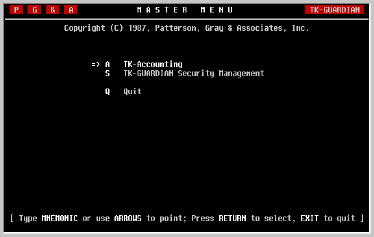
and/or application screens. While each menu's content is different, each functions in like manner. The following example illustrates how the first menu in the system will appear.
Notice the '=>' pointing to the first item on the menu. Referred to as the selection pointer, it identifies the option which would be chosen if you were to press the [RETURN] key. It can be moved in several ways. You can use the [SPACE] key or cursor [DOWN] key to move the pointer down the list of items. When it points to the desired option, simply press [RETURN]. Of course you can also move the selection pointer up the list using the cursor [UP] key. If there is more than one column of items in the menu you can also use the cursor [RIGHT] and cursor [LEFT] keys to move the pointer around. This type of item selection is often referred to as the Point 'N Shoot method and is very easy to both learn and use.
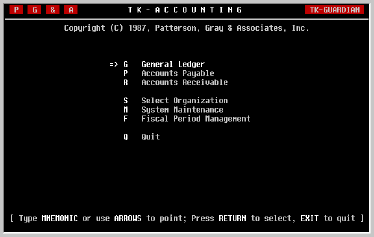
Another method of selecting an item involves typing one or more of the characters to the left of the desired item (called a Mnemonic ) until the selection pointer has found and points to the correct one. For example, to select System Maintenance in the menu shown above, you could press a [M]. The selection pointer would find and point to the correct item and you could then press [RETURN].
NOTE: Some systems are configured so that the [RETURN] is not required after typing the identifying characters. As soon as the menu knows which item is being selected, it proceeds directly to that item without waiting for [RETURN] to be pressed.
| ||||||||||||||||||||||||||||||||||||||||||||||||||||||||
| The EXIT Key | Now that you know how to select
an item on a menu, it will also be helpful to know how to quit a menu.
Some menus actually have an item called Quit which you can select
like any other item. However, not all do. In such a menu, you need to
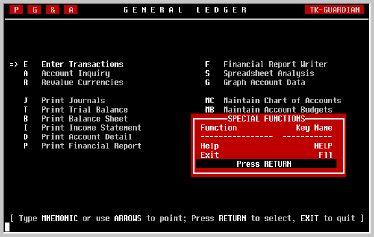
press the EXIT key. But which key is it? As the following example shows, you can find out by pressing a [?] at any menu. A small window will appear which identifies several important keys on your keyboard. This is necessary because TK-LEDGER supports a wide variety of terminals many of which employ different keyboards.
| ||||||||||||||||||||||||||||||||||||||||||||||||||||||||
| Shortcuts | The TK-GUARDIAN system also
provides a means for users to define their own shortcuts to items which
they use frequently. To add a shortcut, the user points to the item that is to be named and presses the [+] key. For example, if Account Inquiry in the GENERAL LEDGER menu is an item that will be frequently needed, proceed to the menu, point to Account Inquiry, and press the [+] key. You will be asked to give the item a name. In this case let's use INQ as the name we will remember. After typing in the name, press [RETURN]; the shortcut is now added for you. To use the shortcut from anywhere in the menu system, press the slash [/] key. You will be asked for the shortcut name at the bottom of the screen. Enter INQ and press [RETURN]. Without having to go through all the menus and keystrokes in between, you're there. For more information regarding shortcuts and security, refer to the TK-GUARDIAN Reference Manual. | ||||||||||||||||||||||||||||||||||||||||||||||||||||||||
Multi-Currency | TK-LEDGER is designed to work equally well in either single or multi-currency situations. In the Organization Maintenance screen you are given the opportunity to decide whether or not the organization will use the multi-currency characteristics of the software. Even if you choose not to use them, you may find the following discussions of interest. | ||||||||||||||||||||||||||||||||||||||||||||||||||||||||
| Currency Definition | TK-LEDGER is provided
with a utility for creating as many currencies as are needed to satisfy an
organization's needs. And additional currencies can be defined whenever
necessary. The utility will require a one-to-three character name, such as
US$, which will be used throughout the system to designate the
currency. Each currency is also given a description, such as U. S.
Dollars, and the number of decimal places the currency will use for
fractional quantities. Also, in multi-currency implementations, each currency is assigned an income (or expense) account in which the gain (or loss) of exchange rate fluctuations is to be recorded. Currencies may be assigned their own unique account to enable the performance of each currency to be tracked individually, or they may share an account if this level of detail is not of interest. | ||||||||||||||||||||||||||||||||||||||||||||||||||||||||
| Base Currency | Every organization must indicate a base currency. This is the currency in which the organization's financial statements will be produced. All other currencies will be considered foreign. | ||||||||||||||||||||||||||||||||||||||||||||||||||||||||
| Exchange Rates | Every foreign currency is
given an exchange rate which is used to compute the base currency
equivalent of transactions entered in that currency. The exchange rate
is expressed as the number of units of the foreign currency which equal
one unit of base currency. For example:
If 76 YEN are equivalent to 1 US$ then the exchange rate is the reciprocal of 76, or the result of dividing 1 by 76, or .031578. Default exchange rates for each foreign currency can be updated as frequently as desired, and can be accepted or overridden during data entry. | ||||||||||||||||||||||||||||||||||||||||||||||||||||||||
| Accounts |
In TK-LEDGER, each G/L detail account is assigned a
currency. For capital or equity, income and expense accounts the currency
assigned will be base currency. Asset and liability accounts may be
assigned any currency. For example, if an organization maintains a
checking account in Japanese yen, an asset account would be created for it
and assigned YEN as the currency. All foreign currency G/L accounts are maintained in the assigned currency. That is, a yen account will be composed of yen transactions. However, to enable production of financial statements, TK-LEDGER also maintains a base currency equivalent of the account. As the currency's exchange rate rises and falls, the Currency Revaluation screen will be used to maintain base currency equivalence and provide the necessary audit trail. | ||||||||||||||||||||||||||||||||||||||||||||||||||||||||
| Data Entry | All data entry screens have been designed to minimize the effort associated with entering multi-currency transactions. Default exchange rates are maintained in the Exchange Rate Maintenance screen, and can be either accepted, or modified during transaction entry. | ||||||||||||||||||||||||||||||||||||||||||||||||||||||||
| Currency Revaluation | Currency revaluation
is the process by which the base currency equivalent of foreign currency
accounts is maintained. At the end of an accounting period, for example,
it is desirable to revalue all foreign currency accounts. This is
done quite easily by selecting the currency and entering its exchange rate
and the date on which the rate became effective. The Currency Revaluation screen will then find all asset and liability accounts which have been assigned the selected currency, compute their new value, and display this value for review. If posted, a journal entry will be made which changes only the base currency equivalent for each account and documents the transaction for the audit trail. The net change of the entry will be posted to the selected currency's gain (or loss) account. | ||||||||||||||||||||||||||||||||||||||||||||||||||||||||
| Reporting | While audit trail reports document the foreign currency amounts and exchange rates used in each entry, all financial statements will report the organization's operating status in its own currency. |